BuildOrbit
All Projects

Patient Delivery Desk

A patient asks for a medicine from the doctor’s code, the nearest rep delivers it, and the next dose is remembered.

An interactive prototype for a pharma home-delivery programme. Each doctor has a code, QR and link. The patient enters an address, picks the medicine and adds a prescription photo; the pincode finds the nearest rep, who accepts the job, delivers, collects payment and sets the next-dose reminder. Managers see their own team and administrators see every request.

Client delivery. The product was designed and engineered as studio work for the team that owns it.

PharmaceuticalPatient Delivery PrototypeWorking demoWebMobile Web

What the prototype shows.

A pharma client wanted reps to deliver a doctor-recommended medicine to the patient’s home and remind them before the next dose. Before building it for real, they wanted to try the whole loop on a phone, from the clinic code to the refill reminder.

  • Start from the clinic

    The patient scans the doctor’s QR or opens the link the doctor sends, and never searches for a doctor.

  • Request in one screen

    Name, delivery address, pincode, medicine and a prescription photo.

  • Route to the nearest rep

    The pincode decides which rep sees the job.

  • Deliver from a job card

    Accept, call, open the address, view the prescription, collect cash or UPI and mark delivered.

  • Remember the next dose

    The rep sets the frequency at delivery, and patient and rep are reminded when it’s due.

  • See the programme

    Managers see their own reps read-only; administrators see every request across India.

The request

From the doctor’s code to a request in one screen.

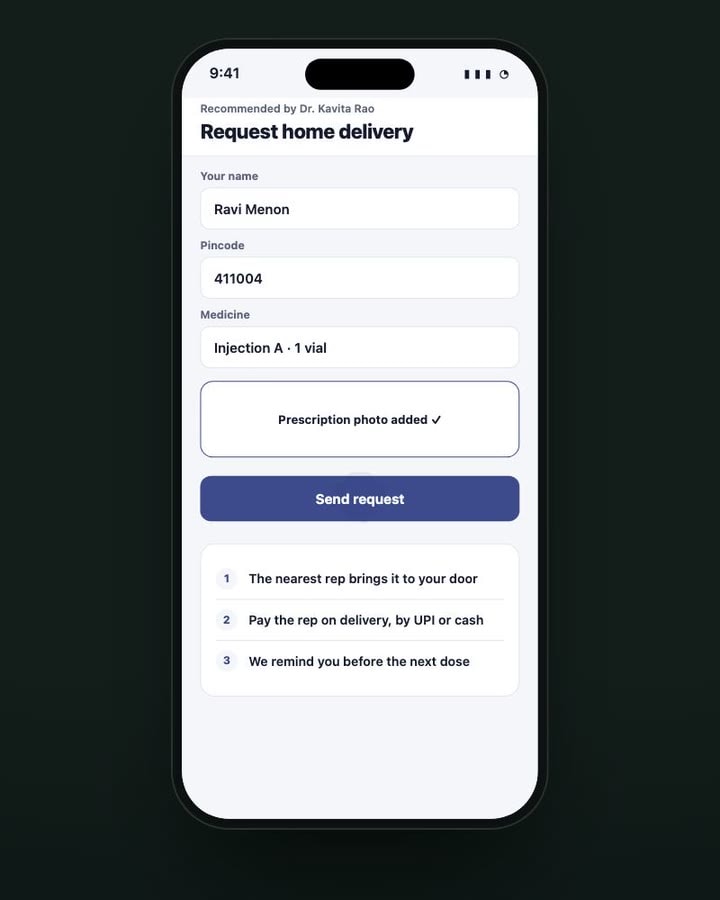
Every doctor has their own code, QR and link, so the request is attributed from the start. The patient fills in their name, delivery address and pincode, picks the medicine and adds a photo of the prescription. No account, no app to install.

  • Doctor-bound QR and link
  • Prescription photo with every request
  • Tracking card with the assigned rep
Request home delivery: patient name, pincode, medicine and prescription photo added, with a Send request button
Recreated from the product, with sample data.

The delivery

The nearest rep gets a job card.

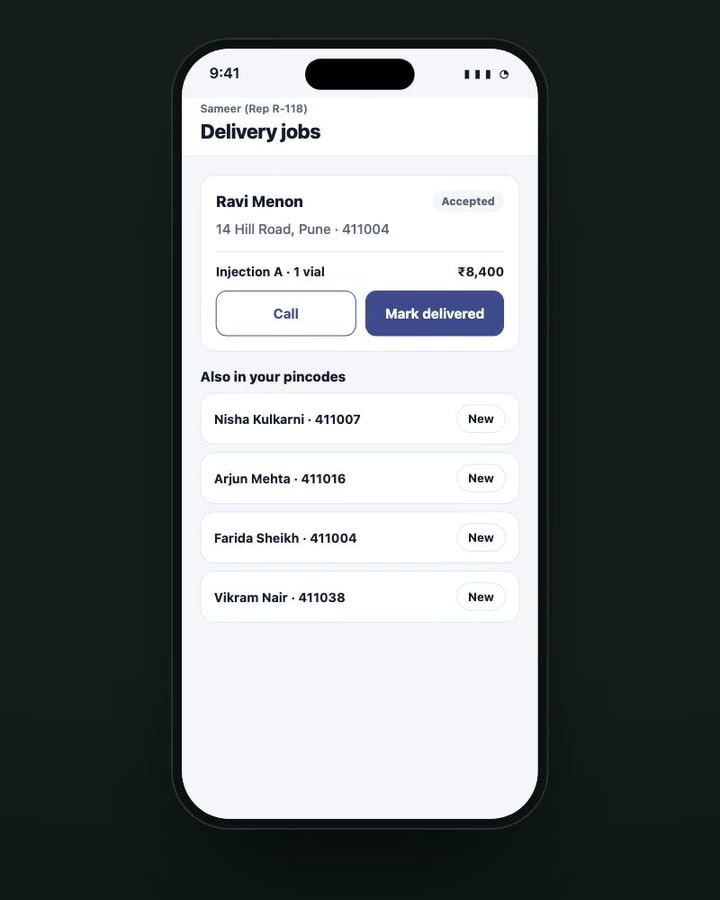
The pincode maps the request to the nearest rep, who sees it with the patient’s address, medicine and amount. The rep accepts, calls, delivers, collects the payment by cash or UPI and marks it delivered. Other open jobs in their pincodes stay listed below.

  • Jobs only in the rep’s mapped pincodes
  • Call, address and prescription on one card
  • Payment recorded at the door
Delivery jobs: an accepted job with address, medicine and amount and a Mark delivered button, with more jobs in the rep's pincodes
Recreated from the product, with sample data.

The next dose

Delivery sets up the refill.

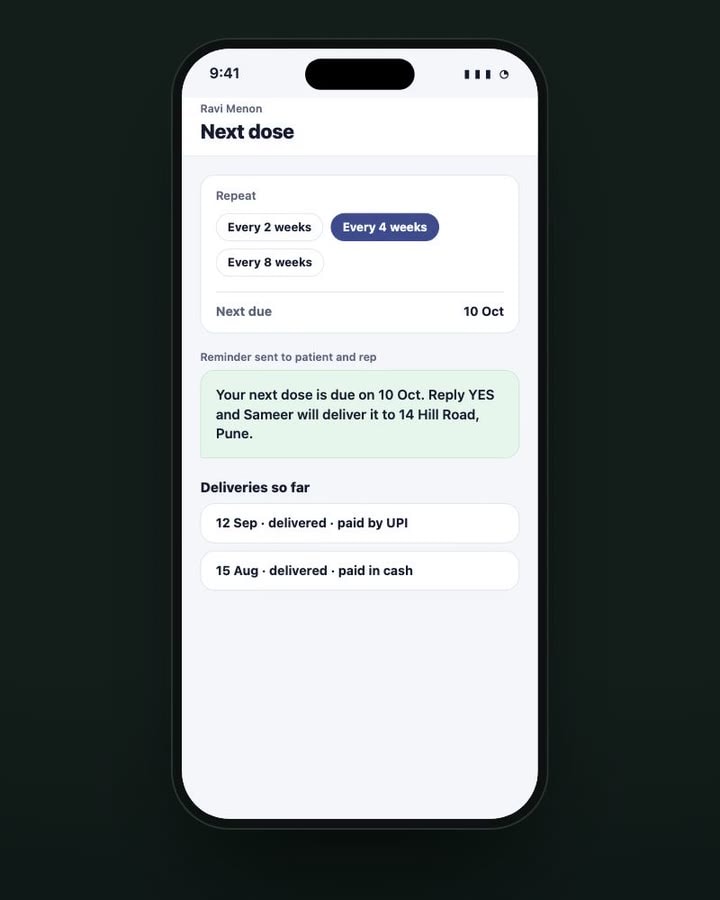
At delivery the rep picks how often the patient needs the medicine. When the next dose is due, both the patient and the rep get a reminder, and the delivery history stays on the patient’s card. Managers can inspect their team’s jobs but never change them.

  • Refill frequency set at the door
  • Reminders to patient and rep (mocked in the prototype)
  • Delivery history per patient
Next dose: every 4 weeks selected, a reminder message to the patient and rep, and the deliveries so far
Recreated from the product, with sample data.
For the technical folksHow it’s builtThe full feature list and the tools behind it.
  • A code, QR and link for each doctor
  • Patient request with address, medicine and prescription photo
  • Pincode-based assignment to the nearest rep
  • Job cards with call, address, prescription and amount
  • Cash or UPI collection on delivery
  • Refill reminders set at delivery
  • Read-only team view for managers, full view for administrators
  • Production-shaped screens over sample data
ReactViteTypeScriptTailwind CSS

Building something with this level of complexity?

If you're planning a patient delivery prototype with real delivery constraints, we can help you scope it, make the technical calls early, and ship it properly.

Direct technical conversations before scope gets expensive.
Full-stack product delivery from interface to backend to launch.
Clear tradeoffs and execution plans instead of vague agency promises.